Denver businesses are paying for aerial assets they once had no budget for, and the measurable payoff is driving adoption across real estate, construction, energy, and broadcast. From progress reports on active RiNo corridor builds to listing videos in Cherry Creek, professional drone services have shifted from a novelty line item to a standard operational tool.
This guide breaks down exactly where professional drone services in Denver save time and money, what compliance requirements protect your business from regulatory and liability exposure, and how to evaluate a local provider before you sign a contract. The data points are specific, the scenarios are real, and the goal is a checklist you can use on your next project.
Last updated: [Month Day, Year]
Key Takeaways
- Every commercial drone flight in Denver requires an FAA Part 107 certified pilot, so hiring a licensed local provider means the compliance burden never lands on your team.
- Denver-based providers with same-day delivery networks cut project turnaround from days to hours for real estate listings, events, and construction progress reports.
- Drone-based site surveys reduce manual surveying time by up to 60 percent, and infrastructure inspections cost up to 55 percent less than traditional methods.
- A single insured Denver drone vendor can cover real estate, construction, energy, film, broadcast, and event work, replacing multiple specialized subcontractors with one relationship.
The Denver Business Case for Professional Drone Services
Denver’s active construction pipeline, high-velocity real estate market, and film-friendly Front Range climate have created consistent demand for aerial content and aerial data. Professional drone services fill that demand faster, at lower cost, and with tighter compliance than any ground-based alternative.
The math is direct: a traditional scaffolding-based roof inspection ties up a crew for most of a workday, while a drone completes the same survey in under an hour. That time difference scales quickly for any business managing multiple sites, recurring inspection schedules, or tight marketing deadlines.
The global commercial drone services market was valued at $30.02 billion in 2024 and is projected to reach $54.64 billion by 2030, a growth rate that reflects how broadly businesses have validated the return on investmen t. Denver sits in a market segment, real estate and construction combined with energy and media, that accounts for a large share of that adoptio
n.
Local providers in Denver serve not just the city proper but the broader Front Range corridor, covering projects from Boulder to Castle Rock without the travel fees and coordination delays that come with hiring an out-of-state operator. That geographic coverage directly reduces the logistics overhead a Denver business absorbs when managing a multi-site aerial project.
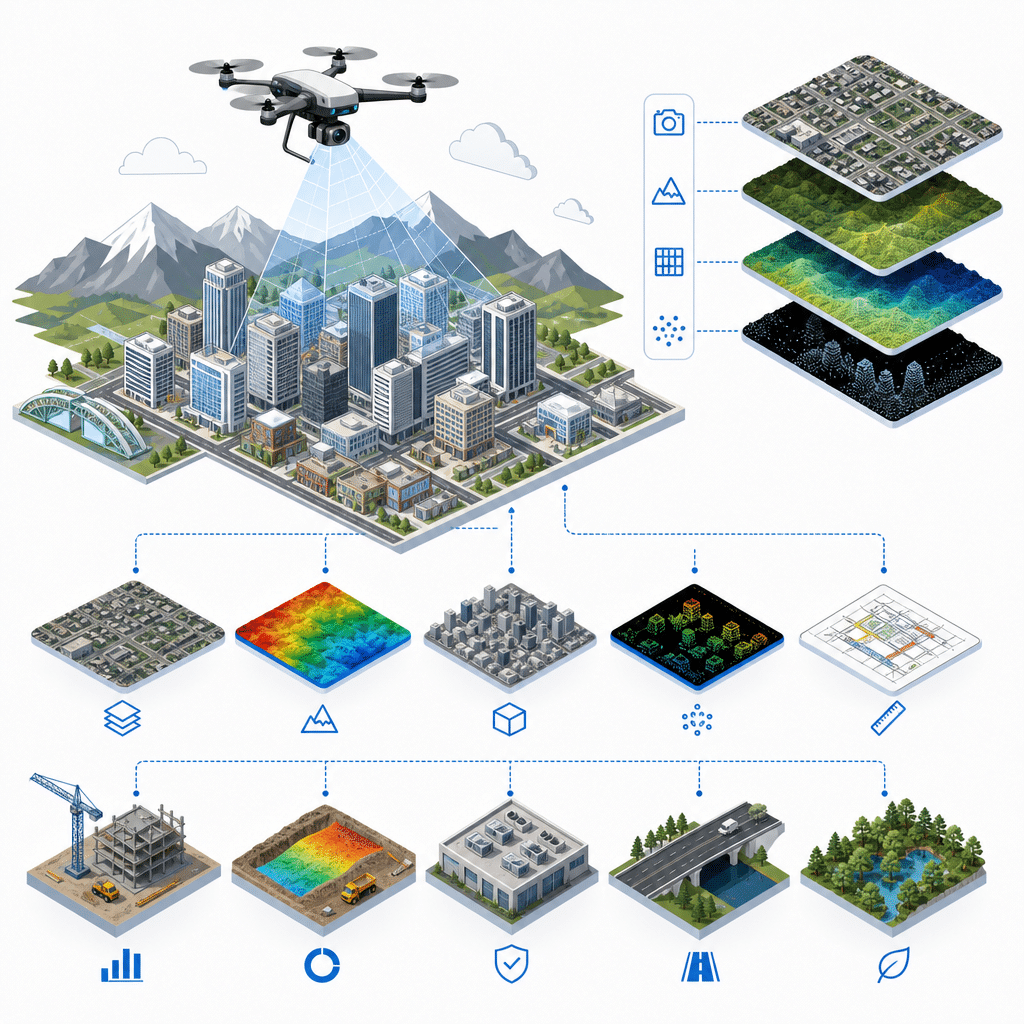
Professional Drone Services in Denver: Key Stats and Benchmarks
Pricing reflects 2024-2025 Denver Front Range market rates. Inspection and survey savings sourced from industry analysis cited in construction sector adoption surveys and infrastructure cost studies.
FAA Part 107 and Denver Airspace: What Compliance Really Means for Your Business
Every paid drone flight in the United States requires the operator to hold a current FAA Part 107 Remote Pilot Certificate. When you hire a professional Denver provider, that certification is already in place, and the compliance burden stays entirely on the operator rather than on your team.
Denver sits within or adjacent to the controlled airspace of Denver International Airport, Centennial Airport, and Rocky Mountain Metropolitan Airport. Flights near those facilities require LAANC authorization filed in advance, and a qualified provider handles that paperwork as a routine step in project planning, not as an exception that delays your shoot.
Reputable Denver operators also carry commercial liability insurance, with leading providers holding policies at one million dollars in coverage or more. That coverage creates a direct financial protection layer for your business in the event of an incident, a layer that simply does not exist when you hire an unlicensed operator to save a few hundred dollars.
Asking to see a current Part 107 certificate and a certificate of insurance before signing takes about five minutes and eliminates an entire category of regulatory and liability risk. Any legitimate professional provider will produce both documents on request without hesitation, and any provider who cannot should not be hired.
Where Professional Drone Services Save Denver Businesses the Most Time
For real estate professionals, drone photography delivers listing-ready aerial stills and video in a single shoot, with established Denver networks offering same-day delivery for projects booked within the metro area. That speed matters directly when a property needs to go live before the weekend and the window for a traditional photography session has already closed.
Construction teams managing active Denver sites use drone surveys to replace manual ground measurements, cutting site survey time by up to 60 percent compared to traditional crews. At that rate, a two-day manual survey on a large residential or commercial project can be compressed into a single morning flight, freeing your crew for other critical-path work.
Infrastructure and energy clients along the Front Range benefit from drone-based inspections of rooftops, solar arrays, and utility corridors that would otherwise require scaffolding, boom lifts, or rope-access technicians. Industry data puts drone inspection costs at up to 55 percent less than traditional methods, a reduction that compounds across every scheduled inspection cycle.
Event and broadcast clients also gain from compressed timelines: a Denver drone crew captures aerial footage of a concert, sports event, or film location and delivers edited content the same day. That eliminates the scheduling gap that traditionally separated a shoot day from a delivery day, a gap that slows marketing campaigns and post-production pipelines.

The Real Cost Savings: Numbers Denver Businesses Can Budget Against
Real estate shoots with edited deliverables in the Denver market typically run $400 to $900, while hourly commercial project rates range from $150 to $400 per hour in the current U.S. marke t. Compare either figure to the cost of a traditional aerial photography helicopter charter, and the savings per project are immediate and easy to quantif
y.
For construction and facilities clients, the more significant number is the 55 percent cost reduction documented for drone-based infrastructure inspections versus traditional methods. A Denver property manager overseeing multiple commercial rooftops, HVAC systems, or parking structures can run that calculation against an annual inspection budget and identify real dollar savings within a single contract year.
Energy sector operators along the Front Range have documented operational cost reductions of up to 40 percent by deploying drones for wind turbine and solar panel inspections. Those savings come from replacing crew time, specialized equipment rental, and access rigging with a single drone flight that delivers thermal imaging data in a fraction of the time.
There is also the often-overlooked cost of repeat shoots: when a professional Denver operator delivers 4K or 6K footage correctly on the first flight, you skip the second crew day you would pay for to fix framing, focus, or coverage gaps. High-resolution, production-grade assets from a qualified provider cut rework out of the project budget before it accumulates.
Industry Verticals Where Denver Drone Services Deliver the Clearest ROI
Real estate is the highest-volume use case for Denver drone services, with 82 percent of luxury listings over $1 million now including drone photography as a standard marketing component. Residential and commercial brokerages that skip aerial content are presenting their properties at a consistent visual disadvantage against comparable listings that include it.
Construction teams on Denver’s active development pipeline use drone data for progress reporting, volumetric stockpile analysis, and multi-contractor coordination across large sites. Drone-generated 3D models built from aerial photography and LiDAR can be exported directly into CAD workflows, eliminating a separate manual modeling step and reducing the delay between site activity and design-team awareness.
Film and broadcast clients working on Front Range productions have access to professional-grade platforms including FPV drones, Inspire 3, Alta X, and heavy-lift systems capable of carrying cinema-quality cameras. That equipment range means a single Denver drone vendor can cover narrative film, commercial advertising, live broadcast, and sports capture without requiring multiple specialized subcontractors for different shoot types.
Energy and utility operators along the Front Range corridors represent a high-ROI inspection category where thermal imaging drones identify hotspots, failing solar panels, and equipment anomalies across large arrays in a single coordinated flight. Catching a failing component before it causes a system shutdown prevents costs that routinely exceed the annual cost of the inspection program itself.
How to Choose a Professional Drone Services Provider in Denver
The minimum threshold for any Denver drone provider is a current FAA Part 107 certificate and a commercial liability insurance policy with at least one million dollars in coverage. Both documents should be available before any contract is signed, and verifying the certificate number on the FAA public registry takes about two minutes.
Local operational knowledge matters as much as credentials. Denver’s elevation, variable Front Range wind patterns, and proximity to multiple controlled airspace zones mean a provider with consistent local experience will schedule shoots more reliably, anticipate weather windows more accurately, and encounter fewer flight-day surprises than an out-of-area operator unfamiliar with the terrain.
Portfolio match is the third criterion: a provider with a documented track record in your specific vertical, whether that is construction documentation, energy inspection, real estate, or broadcast, will deliver usable assets on the first flight rather than learning your industry’s deliverable requirements on your budget and your timeline.
Finally, confirm delivery timelines and post-production capabilities before booking. Same-day and next-day delivery is available from established Denver drone networks with in-house editing teams, and knowing that turnaround commitment upfront allows you to build your marketing, reporting, or inspection schedule around a reliable production clock.
Frequently Asked Questions
What makes a drone service ‘professional’ versus hiring an unlicensed operator?
A professional drone service holds a current FAA Part 107 Remote Pilot Certificate, commercial liability insurance, and files required LAANC authorizations for Denver’s controlled airspace zones. An unlicensed operator exposes your business to FAA enforcement risk, liability gaps, and footage that may not be legally usable in paid commercial contexts.
How much do professional drone services cost for a Denver business?
Real estate shoots with edited deliverables in the Denver market typically run $400 to $900, and hourly commercial rates range from $150 to $400 per hour in 2025. Full-day construction or mapping projects commonly run $1,000 to $3,000 depending on deliverables, equipment, and post-production scope.
Can a Denver drone provider really deliver footage the same day?
Yes, local Denver pilot networks with in-house editing teams do offer same-day delivery for projects booked within the metro area. Same-day turnaround is most common for real estate shoots, event coverage, and short commercial projects where the editorial scope is defined clearly before the flight.
Which industries in Denver benefit most from professional drone services?
Real estate, construction, energy and utilities, film and broadcast, and large-event marketing are the primary use cases among Denver businesses. A single experienced drone provider can serve multiple verticals, which consolidates vendor relationships, reduces per-project coordination overhead, and creates a consistent asset quality standard across your organization.
Understanding the full range of applications starts with a clear view of what Civilian Uavs are already doing across industries and where the technology is headed next.
Do I as the client need to worry about Denver airspace regulations?
No, the airspace compliance burden falls entirely on the licensed operator, not the client hiring the service. A qualified Denver drone provider files LAANC authorizations for flights near DIA, Centennial Airport, and Rocky Mountain Metropolitan Airport as a standard part of project planning.
What resolution should I expect from a professional Denver drone service?
The current professional baseline is 4K video with 24-megapixel or higher still photography, and top Denver providers offer up to 6K video and ultra-high-resolution aerial imaging for broadcast or production-grade deliverables. Providers still delivering 1080p footage as a default are operating below the current market standard.

About the author
Steve Dempsey - Owner
Steve Dempsey operates Sky Drone Solutions, a Fort Collins, Colorado provider of aerial photography, videography and drone inspection services for construction, agriculture and industrial clients. He brings 25 years in the technical, IT and business operations world, and also owns NeoTech Networks LLC, a managed IT services company.